

In Nigerian real estate, the most reliable early signal of value appreciation is the development of an infrastructure corridor.
When a new road, corridor, or expressway extension is introduced, and, more importantly, when it is complemented by broader developments such as transport systems, industrial zones, and logistics hubs, the surrounding land market begins to reprice in anticipation, often well before project completion. Research in Lagos found that properties close to arterial roads and transport corridors generate rental premiums of 25 to 68 percent compared to unconnected locations. In Abuja, districts with active infrastructure investment have seen 15 to 40 percent price appreciation over two to three years.
Despite this correlation, the relationship between infrastructure and property value is not uniform. It depends on what is being built, where, and for whom. In 2026, both Lagos and Abuja are in the middle of a major corridor-driven transformation. This article examines the infrastructure corridors currently reshaping property markets in Lagos and Abuja, the value signals they are generating, and what investors and developers need to understand about each city’s specific dynamics.
What Infrastructure Development Really Means
In the context of real estate, infrastructure development is often narrowly interpreted as the construction or expansion of roads. While road networks are indeed a visible and critical component, they represent only one layer of a much broader system that drives urban growth and property value.
In reality, infrastructure encompasses a network of interconnected assets, including ports, industrial zones, power supply, transport systems, and economic hubs, all of which collectively shape how people live, work, and move within a city. It is this integrated framework, rather than any single project, that defines the true strength of an investment corridor.
Infrastructure corridors, therefore, are not simply defined by improved road access. Instead, they emerge where multiple layers of development converge to create sustained economic activity. The presence of large-scale employment generators, such as industrial facilities and free trade zones, combined with logistics networks and supporting social infrastructure, ultimately drives long-term real estate demand.
Infrastructure Corridors Restructuring Urban Areas In Lagos
Lagos has over 16 million inhabitants and is projected to reach 24 million by 2035. With this growing population, mobility and access have become the primary determinants of which areas are investable and which are not. The city’s strategic transport master plan, which combines bus rapid transit, rail, and road corridor development, is directly influencing the geographical variation in real estate value.
The Lekki-Epe Corridor
The Lekki-Epe corridor remains the most mature example of infrastructure-led real estate investment in Lagos. Over the past decade, what was once a speculative land frontier has steadily evolved into a structured growth corridor, underpinned by large-scale infrastructure, industrial activity, and increasingly coordinated urban expansion.
The drivers are substantial, and a major driver of this transformation is the Lekki Deep Seaport, now operational and expanding. Its impact on the corridor is both immediate and structural, driving a surge in industrial and logistics demand that is fundamentally different from the speculative residential cycles that previously defined the area. In effect, this is not just growth; it is demand anchored in trade, movement, and economic production.
Closely linked to this momentum is the presence of the Dangote Refinery, which has emerged as a defining anchor for the corridor’s economic transformation. With a current capacity of approximately 650,000 barrels per day and expansion plans underway, the refinery is not only a major industrial asset but also a powerful driver of real estate activity. Specifically, it is catalysing job creation, attracting a wide network of contractors and service providers, and, in turn, stimulating demand for residential housing and commercial support infrastructure across Ibeju-Lekki and extending toward Epe. While short-term pressures such as increased truck traffic and congestion persist, these have, in turn, accelerated road upgrades and broader infrastructure investment along the axis.
In addition, developments within the Lekki Free Trade Zone, such as Alaro City, further reinforce this shift. For instance, the presence of TY Logistics Park FZE, a 29,000 square metre contract logistics hub, signals the corridor’s emergence as a credible logistics backbone for Lagos and, increasingly, West Africa. Public sector intervention is also shaping the residential narrative. The Renewed Hope Housing Programme, for example, has approximately 2,000 housing units nearing completion in Ibeju-Lekki, thereby introducing structured housing supply into a market that has historically been driven by private estate developments. From a pricing perspective, the data reflects a market that is both active and appreciating. Serviced plots along this corridor currently range between ₦50 million and ₦90 million per 600 square metres. More importantly, annualised returns are being recorded in the 20 to 28 per cent range, driven by the combined effects of ongoing coastal highway development and continued expansion around the port.
Prime industrial rents in leading Lekki corridor zones range between $4.0 and $6.5 per square metre, a significant premium over the $3.0 per square metre characteristic of Grade B and C stock outside special economic zones. The corridor has moved beyond speculative land play to become a functioning logistics and industrial ecosystem with residential demand following employment.
The ongoing expansion and dualisation of the Lekki–Epe Expressway continues to play a critical enabling role. By directly addressing congestion and improving connectivity between Lekki, Ibeju-Lekki, and Epe, these upgrades are significantly enhancing land accessibility along the corridor. Consequently, areas that were previously considered peripheral are now being repositioned as viable locations for both residential estates and commercial developments.
The proposed Lekki International Airport is a forward-looking infrastructure planning that will further strengthen the Lekki-Epe corridor’s long-term outlook. The airport, which is expected to be developed within the Lekki axis, introduces an additional layer of connectivity and economic potential. Designed to handle millions of passengers annually and integrate with existing logistics infrastructure, the airport is poised to complement the deep-sea port and free trade zone ecosystem. As such, it is expected to drive sustained appreciation in land values, particularly across industrial and logistics clusters, while also supporting residential demand.
What is most significant, however, is the structural shift underway. The Lekki–Epe corridor has moved beyond the phase of speculative land accumulation and is steadily evolving into a major mixed-use hub, encompassing residential, commercial, industrial, and hospitality developments.
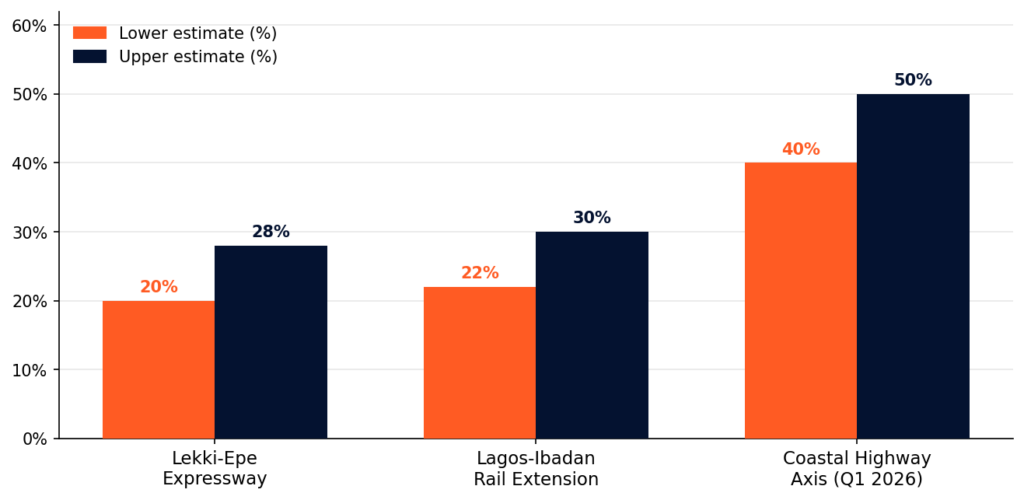
Annualised Returns Across Lagos Infrastructure Corridors (2026)
The Lagos-Calabar Coastal Highway
The Lagos-Calabar Coastal Highway is, in scale and ambition, among the most significant infrastructure projects currently underway in West Africa. The Lagos portion, starting at Victoria Island and running along the coastline to Eleko Junction, is currently under active construction. Sections have already been opened, featuring carriageways, solar lighting, drainage systems, retaining walls, and interchanges.
Even at this early stage, its market impact is already measurable. Properties across Ibeju-Lekki, Eleko, and parts of Epe, previously discounted due to perceived distance from core commercial hubs, are now being repriced upward in anticipation of significantly reduced travel times and improved coastal access. Reports from Q1 2026 indicate land value increases in the range of 40 to 50 per cent along directly impacted stretches.
However, the true significance of the highway extends well beyond immediate price appreciation. Structurally, it is designed to decongest the saturated Lagos-Ibadan and Benin-Ore axes, connect ports and industrial zones with free trade areas, and integrate coastal hubs that have historically been treated as peripheral. For investors, the highway is restructuring what peripheral means in Lagos real estate. Areas once excluded from serious institutional consideration are now within a credible investment timeline.
BRT Corridors and the Transit-Value Link
Beyond highways, urban mobility infrastructure continues to demonstrate a direct and measurable relationship with real estate performance in Lagos.
Research examining property values across nine major road corridors in Lagos found that properties within 500 m of BRT corridors command a 30 – 68% premium over properties more than 1 km from transit access. Road quality strongly predicted commercial rental value, and infrastructure accounted for more than 70% of the variation in commercial rental values. The finding showed that infrastructure dominates commercial property performance in Lagos.
Lagos currently operates eight BRT corridors, transporting over 200,000 passengers daily. More importantly, ongoing rail-integrated transit expansion is deepening this impact. The Red Line between Agbado and Marina is projected to service around 500,000 daily passengers, and the Blue Line between Marina and Mile 2 is being extended. Each commissioned line represents a quantifiable shift in the accessibility rate, and therefore the value gradient, of the surrounding areas.
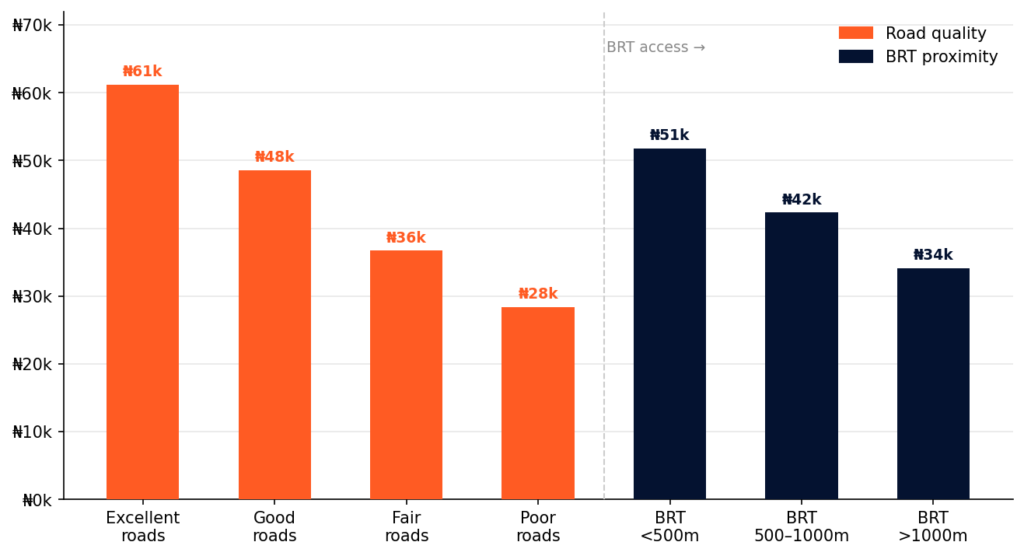
Commercial Rental Value by Road Quality and BRT Proximity in Lagos (₦ per m² per annum) Source: Abidola et al. (2025)
The Lagos-Ibadan Rail Extension: Mowe to Abeokuta
Beyond the coastal and expressway corridors, the Lagos-Ibadan rail extension covering the Mowe-Ofada-Shimawa-Abeokuta stretch is generating its own investment cycle. Serviced plots of 600 square metres along this corridor currently range from ₦45 million to ₦85 million, with documented annualised returns of 22 to 30 percent, driven by full rail operations expected by mid-2026, combined with industrial spillover from the corridor’s manufacturing and logistics base.
Fundamentally, rail infrastructure introduces a different value dynamic. By enabling predictable, high-capacity commuter movement, it expands the radius of practical residence and effectively compresses distance. As a result, locations once considered too far from Lagos’ economic core are becoming increasingly viable for both homebuyers and renters. For investors with a 12 to 36-month horizon, the rail corridor presents a documented risk-return profile, provided that due diligence is rigorously applied, particularly around title verification, flood risk exposure, and actual proximity to operational (rather than proposed) rail stations.
Infrastructure Corridors Repricing Property Values in Abuja
While Lagos is a city of organic expansion and reactive infrastructure investment, Abuja was designed as an infrastructure-led city, with the principle that infrastructure precedes occupancy. In practice, this has created a clear and measurable relationship between infrastructure provision and property value. Districts delivered with fully installed roads, drainage systems, utilities, and power infrastructure have consistently outperformed those where such systems remain incomplete or delayed.
According to findings from industry professionals in Abuja, three-bedroom apartments in fully serviced areas like Maitama, Wuse II, and Asokoro achieve average annual rents between ₦8 million and ₦10 million, with capital values ranging from ₦400 million to ₦800 million. In areas with delayed or inadequate infrastructure, such as Kuje and Karshi, comparable properties achieve annual rents of ₦1 million to ₦2.5 million, with capital values between ₦40 million and ₦70 million. The infrastructure differential accounts for a value gap of roughly eight to ten times between the most and least serviced districts. The concentration of capital in specific corridors and districts has directly produced corresponding concentrations of property value.
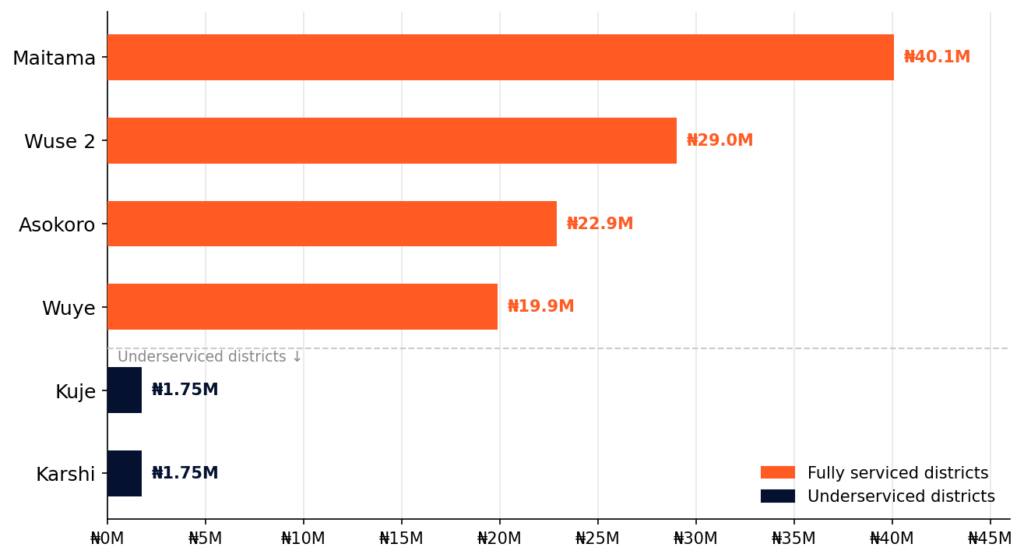
Annual Rent Comparison Across Abuja Districts (₦ per annum)
The Idu Industrial Corridor
Within Abuja, the Idu Industrial Area has emerged as one of the most active economic corridors in 2026. The ongoing development of the Abuja Industrial Park within this zone is projected to generate approximately 40,000 jobs upon full operation, a scale of employment that is already influencing real estate demand patterns.
In response, residential development is beginning to cluster around this industrial base. Projects such as The Glade, developed by Real Forte Estate Limited in the Idu Sabo area, have reported over 200 per cent returns for early-phase investors, alongside rising demand from buyers who missed initial entry opportunities.
The Idu corridor benefits from connectivity infrastructure such as the Inner Northern Expressway, which is improving access and integrating Idu into Abuja’s broader urban framework. way. The connections are creating a suburban cluster that combines industrial employment, commercial activity, and residential demand in a single corridor, which is the most durable form of corridor-driven property value.
The Maitama Corridor and the 2026 FCTA Budget Signal
The Federal Capital Territory Administration’s 2026 budget offers one of the clearest infrastructure investment signals available for property market analysis. Of the total ₦460.73 billion FCTA budget, approximately ₦335 billion, or 73%, is allocated to Maitama and its extension, Maitama II. Maitama already commands some of the highest property values in Nigeria. Nigeria Property Centre data from March 2026 shows the Maitama District with an average house price of ₦1.37 billion, second only to Ikoyi in Lagos at ₦1.82 billion. Annual house rents in Maitama average ₦40.1 million, again behind only Ikoyi at ₦53.2 million nationally.
The budget concentration in Maitama and Maitama II signals that the administration intends to consolidate and extend the premium zone that already commands Nigeria’s highest valuations outside Ikoyi. For investors in Maitama II, which is less developed than the core district, the infrastructure commitment provides a credible basis for anticipating appreciation. Based on reported data, infrastructure announcements in Abuja typically generate 5-10% near-term price increases, with completion adding a further 10-20%.
The ONEX Corridor and the Katampe Extension
The Outer Northern Expressway (ONEX) and the N16 Arterial Road have transformed access to Katampe Extension, a district that was always designated as a diplomatic and high-value residential zone on paper, but which struggled with connectivity in practice. The completion of major interchanges linking Katampe Extension to Maitama and Jahi has removed that barrier. Katampe Extension is now among Abuja’s gentrifying areas alongside Jahi, Dakibiyu, Mabushi, and Kado, all of which have seen price appreciation of 15-30% over the past two to three years, with Kado recording gains of nearly 40%. Properties in emerging areas like Katampe Extension and Jahi are reportedly selling faster relative to two years ago, a liquidity signal that precedes sustained price appreciation. For 2026, projections suggest Katampe Extension prices may outperform the city average by 25-30%.
What You Need to Understand as an Investor in 2026
Infrastructure corridors continue to present some of the most compelling real estate investment opportunities in Nigeria. Data suggests that properties positioned close to major infrastructure developments in Lagos can appreciate by as much as 165 percent by project completion. While most investments do not capture the full range, the data illustrates why infrastructure-adjacent positioning remains the dominant strategy for Nigeria’s property market.
However, some considerations are material to understand the risks that accompany the opportunity. First, the timing of entry matters more than location alone. By completion, prices often already reflect the anticipated benefit. Investors should assess which stage of the infrastructure lifecycle each corridor is in, and price accordingly. Investors who enter at the completion stage are paying a premium that reduces the remaining upside. Secondly, title verification is non-negotiable. For corridor investments in Lagos and Abuja, title integrity determines whether an infrastructure premium can be realised or whether it remains locked behind legal disputes.
Ultimately, successful corridor investing requires more than proximity to infrastructure, it demands a clear understanding of the infrastructure lifecycle, disciplined due diligence, and strategic timing.