

Lagos’s shortlet market has matured from an informal workaround into a structured segment generating hundreds of billions in annual revenue. But as supply expands and narratives outpace data, investors need clarity on what is actually performing, where the yields hold, and where the risks are accumulating. This article draws on market data and industry reports to describe the trends, performance, and risks of the Lagos shortlet market.
How the Lagos Shortlet Market Evolved into a ₦264 Billion Sector
The Lagos shortlet market emerged from a gap between what traditional hotels offered and what a growing class of business travellers, diaspora visitors, expatriates, and domestic leisure travellers actually needed: flexible, well-appointed, home-like accommodation without the formality or price premium of full-service hospitality.
In its earliest phase, the shortlet model was largely informal and fragmented. Individual property owners, particularly in Victoria Island and Ikoyi, began listing furnished apartments for short-term rental through word of mouth and, later, through the initial wave of digital listing platforms. Occupancy was modest, and management was typically self-administered. There was no meaningful data infrastructure, no standardised pricing model, and no recognised investor category for the product type.
Later on, the market introduced scale and professionalism. The rapid adoption of Airbnb and local platforms such as Spleet accelerated listing activity and brought a degree of market transparency. Property management companies entered the space, offering turnkey shortlet management services to landlords who wanted the income without the operational complexity. New apartment developments in Lekki Phase I, Lekki Peninsula II, and parts of Ikeja began incorporating short-term readiness as a design and marketing consideration. The market expanded beyond the island’s luxury corridors into mainland areas, including Yaba, Surulere, and Gbagada.
The COVID-19 period introduced an inflection point. International hotel chains faced occupancy collapses, while shortlets, being smaller, more isolated, and offering kitchen and laundry independence, benefited from a shift in guest preferences toward privacy, self-sufficiency, and domestic travel. The Lagos market captured this demand. By 2022, a peripheral accommodation category had become a defined asset class with its own yield expectations, management infrastructure, and investor thesis.
From 2022 to 2024, the market was characterised by rapid supply expansion and the emergence of what a 2024 report described as market saturation pressures in premium submarkets. Active listings proliferated across every major corridor. The total number of surveyed listings reached 5,806 by 2024. The report’s total estimated market revenue for 2024 stood at ₦264.3 billion, demonstrating the sector’s macroeconomic weight within Lagos’s hospitality and real estate economy.
By 2025, reported figures placed the market’s revenue at an estimated ₦281 billion, with projections of approximately ₦285.5 billion for 2026. While the growth trajectory is real, the market is growing at a slowing rate in an increasingly supply-saturated market, which is a different investment proposition from growth in an undersupplied one.
What Is Actually Driving Shortlet Demand in Lagos and Why It Is Durable
The demand drivers behind the scale of shortlet demand in Lagos are primarily structural, which means they are more durable than trend-driven markets, but they also define the ceiling more clearly than promotional narratives tend to acknowledge.
Business Travel and Corporate Relocation as the Core Demand Engine
Lagos is West Africa’s dominant commercial hub. It hosts the regional or national headquarters of multinational firms across financial services, oil and gas, fast-moving consumer goods, technology, and telecommunications. The city generates a steady, year-round inflow of business travellers, including consultants, corporate executives, regional staff on rotation, and compliance and audit teams, who require accommodation for periods typically ranging from two nights to several weeks.
Across all submarkets tracked in a 2024 study, the dominant booking pattern was for single-night or two-night stays. In Victoria Island, 60% of all bookings were for one night and 21% for two nights. In Lekki Phase I, 53% of guests stayed one night and 30% for two nights. This pattern is consistent with business-travel demand rather than leisure demand, which tends toward longer minimum stays. The implication for investors is significant: high-frequency, short-duration bookings generate strong turnover revenue but also require more active operational management.
The Diaspora Effect and “Detty December” as Seasonal Demand Amplifiers
Nigeria’s diaspora population represents a concentrated, high-spending annual demand event for the Lagos shortlet market. The festive season, colloquially known as “Detty December,” sees a large-scale inflow of diaspora visitors that materially shifts occupancy across all submarkets. In 2024, Lagos reportedly attracted an estimated 1.2 million tourists during the festive period, with approximately 60% being domestic visitors from the South East and FCT and 40% being diaspora visitors. Data from Murtala Muhammed Airport (MMA) indicated that around 550,000 inbound passengers arrived between mid-November and late December 2024, with 90% travelling for leisure and tourism.
The occupancy data reflects this pattern sharply. Across premium island submarkets, December 2024 occupancy rates were 40–50 percentage points higher than January 2024:
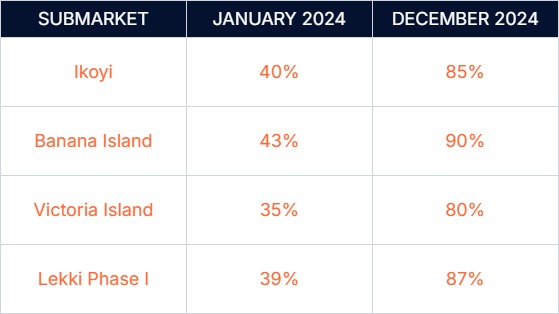
Source: Edala 2025 Shortlet report
These spikes are real revenue events, and they structure the annual yield mathematics of any property in these markets.
The Remote Work and Digital Nomad Dimension
A third driver, still smaller in volume but growing in relevance, is the global shift toward remote work and digital nomadism. For the Lagos market, this translates to a slow but steady increase in extended-stay bookings, particularly in submarkets proximate to business infrastructure such as Yaba’s tech corridor and Victoria Island’s corporate district.
Hotel Substitution and Infrastructure Gaps
A less-discussed structural driver is the consistent gap between hotel supply and demand during peak periods. During Detty December 2025, reported data indicated that Lagos hotels on Victoria Island, Ikoyi, Lekki, and Ikeja were recording near-full occupancy as shortlet nightly rates spiked. This confirms that shortlets and hotels are not simply competing products but they are complementary supply channels serving the same compressed demand curve at different price points and service levels. Lagos does not have the hotel infrastructure to absorb its peak-period demand, so shortlets fill that gap.
Submarket Revenue and Performance: Where the ₦264 Billion Is Actually Concentrated
The aggregate revenue figure for the Lagos shortlet market (₦264.3 billion in 2024) is useful as a macro signal. It is less useful as an investment guide unless decomposed by submarket. The distribution is highly uneven, and the performance characteristics of each submarket reflect fundamentally different demand profiles, pricing architectures, and risk structures.
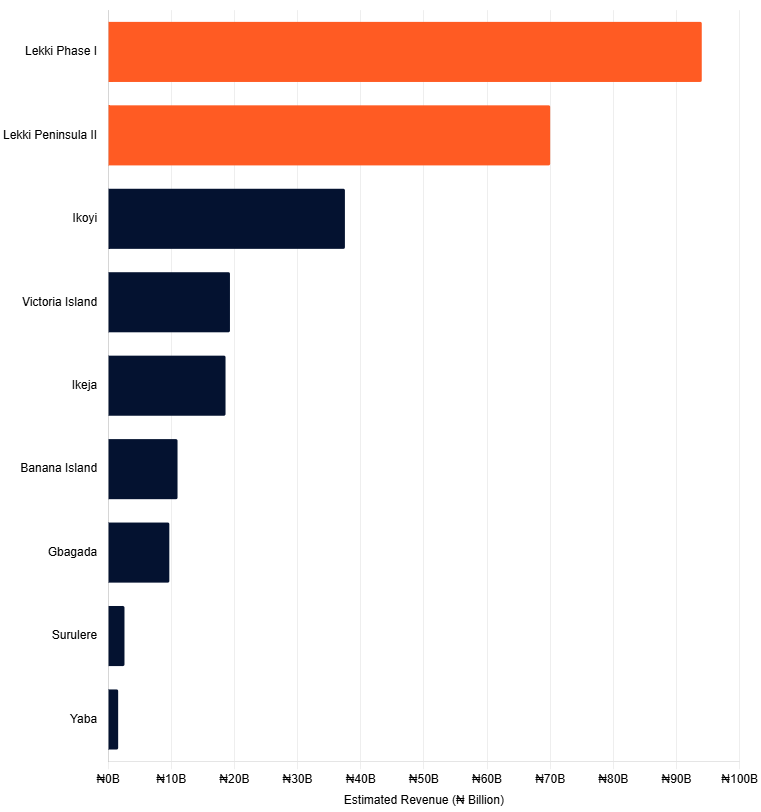
2024 Estimated Revenue by Lagos Shortlet Submarket (₦ Billion)
Lekki Phase I — Highest Volume, Highest Liquidity, Growing Supply Risk
Lekki Phase I is the market’s dominant revenue generator by a wide margin. With 1,621 active listings, an average daily rate (ADR) of ₦253,000, and an average occupancy rate of 63%, the submarket generated an estimated ₦94 billion in 2024. That is 35.6% of the total Lagos shortlet market revenue generated by a single submarket. The pricing range from ₦68,000 per night for a one-bedroom unit to ₦520,000 for a five-bedroom unit reflects a genuinely diverse inventory catering to a broad demand spectrum, from young professionals on short corporate visits to high-net-worth families seeking premium leisure accommodation. Lekki Phase I’s proximity to Victoria Island and Ikoyi, combined with its own vibrant retail, restaurant, and recreational ecosystem, makes it the most liquid submarket in the city from a shortlet perspective.
Lekki Peninsula II — Affordable Island Alternative
This area, covering Ikate, Osapa London, Jakande, Chevron, and Victoria Garden City, is the second-largest submarket with 1,904 listings and an estimated ₦70 billion in 2024 revenue. Its ADR of ₦192,500 is lower than that of Lekki Phase I, and its average occupancy of 53% is also more modest. The submarket functions as an affordable island alternative, close enough to the major commercial corridors to be relevant, distant enough to price below the premium markets.
Ikoyi / Banana Island— Premium Pricing, Exceptional Returns, Strong Corporate Demand
The premium luxury segment is anchored by Ikoyi (₦37.5 billion, 546 listings, ADR ₦314,500, average occupancy 60%), Victoria Island (₦19.3 billion, 481 listings, ADR ₦200,000, occupancy 55%), and Banana Island (₦11 billion, 133 listings, ADR ₦351,000, occupancy 65%). These three submarkets together generate approximately ₦67.8 billion, significant revenue concentrated in a small number of listings, with the pricing power and exclusivity to match. Banana Island’s average daily rate is the highest in the Lagos market, and its occupancy rate is stronger than Victoria Island’s, reflecting the scarcity premium of an inventory-constrained enclave.
Mainland Markets — Value Entry With Caveats
The mainland and mid-market clusters of Ikeja (₦18.6 billion), Gbagada environs (₦9.7 billion), Surulere (₦2.6 billion), and Yaba (₦1.6 billion) collectively generate ₦32.5 billion, or approximately 12.3% of total market revenue. Their absolute revenue figures are modest relative to the island markets, but their growth trajectories and yield-per-unit economics relative to entry cost are a distinct part of the investment conversation.
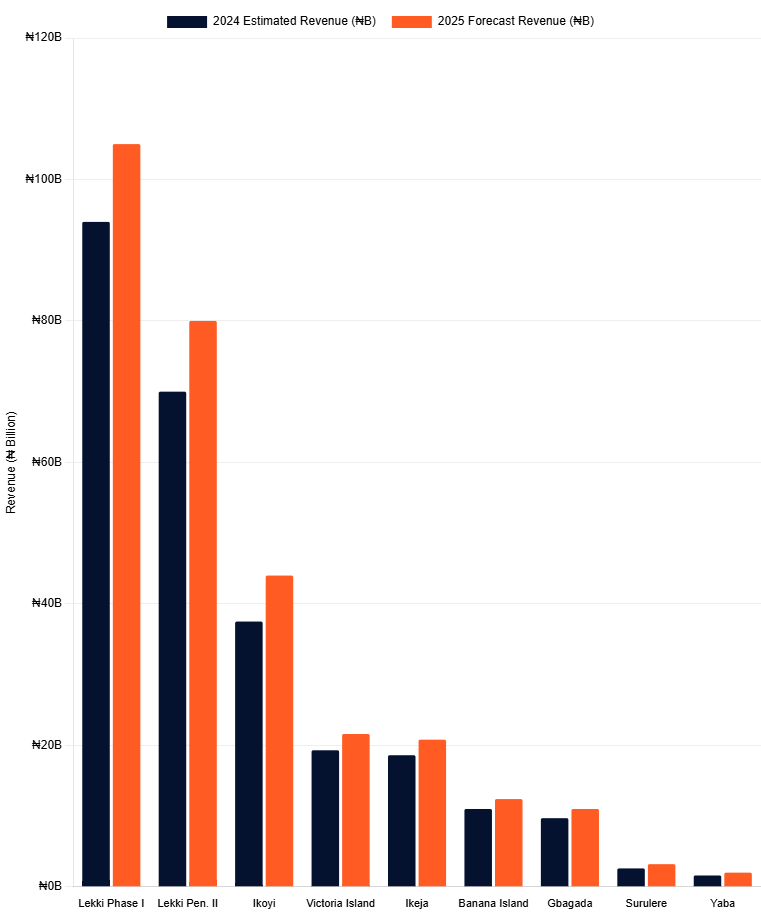
Lagos Shortlet Revenue: 2024 Actuals vs 2025 Forecast by Submarket (₦ Billion)
Yield and Investment Signals: What the ADR and Occupancy Data Actually Mean for Returns
The revenue figures establish the market’s scale. The yield question of what an individual investor can expect in returns on a specific unit in a specific location requires a more granular analysis of ADR, occupancy, and operating cost structures.
The Edala 2024 report provides per-unit annual revenue estimates across bedroom types and submarkets that make yield modelling tractable. The range is substantial. A one-bedroom unit in Lekki Phase I with an ADR of ₦68,000 and market-average occupancy generates an estimated ₦13.1 million per year. A two-bedroom in the same submarket generates approximately ₦35.9 million. A five-bedroom generates ₦119.6 million. In Ikoyi, the numbers are higher: a one-bedroom at ₦133,000 ADR generates approximately ₦31.5 million annually, while a five-bedroom at ₦496,000 ADR generates ₦117.7 million.
In the premium luxury tier, Banana Island’s five-bedroom units at ₦516,000 ADR generate an estimated ₦122.4 million per year. A one-bedroom in Yaba at ₦55,000 ADR generates approximately ₦10.5 million. The per-unit revenue range across the entire market therefore spans roughly ₦5.6 million (Yaba studio) to ₦122.4 million (Banana Island five-bedroom). This is not a single-yield market. Rather, it is a portfolio of sub-markets with distinct risk-return profiles.
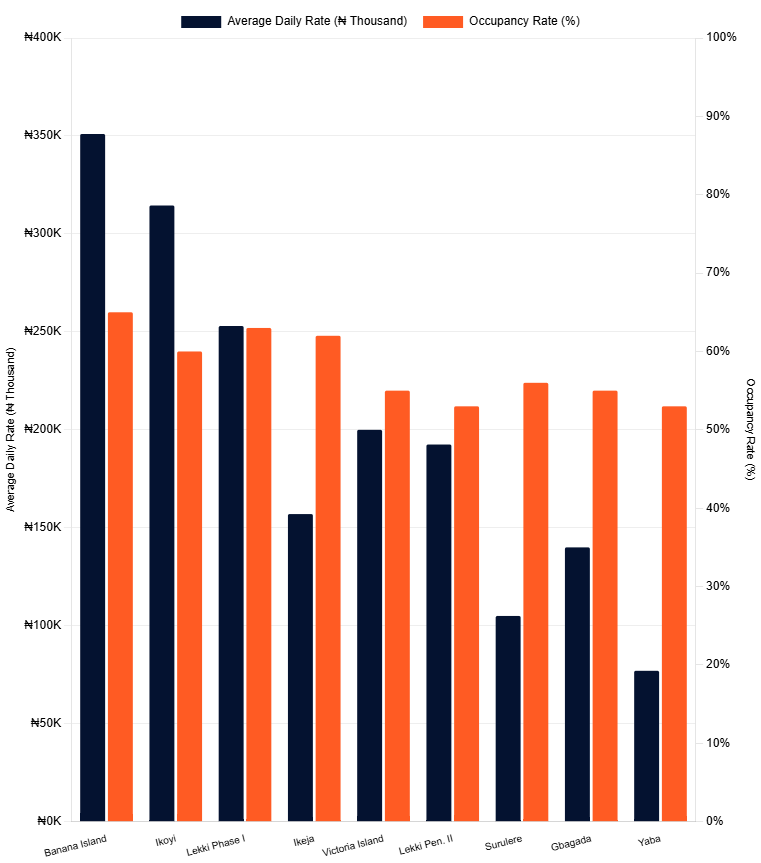
Average Daily Rate vs Average Occupancy Rate by Submarket (2024)
According to reported Q1 2026 data, the Lagos shortlet market delivered an average 24% net yield in Q1 2026, with Lekki Phase I and Extension reportedly achieving 26-32% net yield on furnished two-to-three-bedroom units, and Victoria Island achieving 24-30% net. These figures assume high occupancy scenarios (88-95%) and specific cost structures, and should be used as directional benchmarks, not guaranteed returns.
The cost structure that sits between gross revenue and net yield is the variable that most investors underestimate. Management fees for shortlets run at 18-25% of revenue, significantly higher than the 8-10% typical of long-term lease management, reflecting the higher operational intensity of frequent guest turnover, cleaning, maintenance response, and platform management. Platform commissions add a further 3-15% of booking value. Utilities in Lagos, driven by high electricity tariffs and diesel dependency, represent an additional ₦250,000 to ₦700,000 per month per unit for a well-managed property. Furnishing and fit-out capex for a standard Lagos apartment ranges from ₦2 million to ₦10 million, with the investment amortised over the expected yield period.
The Supply Pressure Signal: What Rising Listings Mean for Occupancy and Per-Unit Revenue
One of the most important shifts in the Lagos short-let market between 2022 and 2026 is the rapid expansion of active listings. Airbtics data as of January 2026 reported that active listings on Airbnb in Lagos grew by nearly 50% year-on-year, reaching approximately 1,361 tracked listings on the platform alone. Simultaneously, median annual revenue per listing declined, and platform-level occupancy fell to approximately 43% for the February 2025 to January 2026 period on Airbnb specifically.
This divergence of a growing aggregate market revenue alongside falling per-listing revenue is the signature of a market entering a supply-saturation phase. Rising competition and market saturation are one of the most pressing topical issues for operators in 2025, with the increasing number of shortlet apartments entering the market creating intensified pressure on both pricing and occupancy rates.
For investors, the implication is a shift in the basis of competitive advantage. In an earlier phase of the market, simply listing a reasonably furnished apartment in a good location was sufficient to generate strong occupancy. In the current phase, performance is increasingly driven by differentiation: superior finishes, professional photography, dynamic pricing tools, concierge services, branded management operations, and the hard-to-replicate signals of consistent quality that generate repeat bookings and positive reviews. The operators capturing the top occupancy rates in 2026 are not necessarily the largest portfolio holders but the most professionally managed ones.
Location Intelligence: Reading the Performance Data Across Submarkets
Lekki Phase I: High Volume, High Liquidity, Growing Supply Risk
Lekki Phase I is the most liquid, highest-revenue shortlet submarket in Lagos. Its 1,621 listings and ₦94 billion in 2024 revenue make it the market’s engine. The demand base is diversified and occupancy has demonstrated consistent seasonal growth over the 2022-2024 period. The December 2024 occupancy peak of 87% confirms the market’s capacity to absorb high-demand seasonal volume.
The risk profile is also the most complex. As the largest submarket by listing count, Lekki Phase I carries the highest concentration of supply risk. A significant proportion of new shortlet inventory entering the Lagos market is concentrated here. Reported 2025 data suggests Lekki Phase I generated approximately ₦93.78 billion in 2025, effectively flat relative to the 2024 estimate, consistent with occupancy compression offsetting ADR growth as supply increased. For investors entering this submarket now, differentiation through quality and management professionalism is the primary yield lever.
Ikoyi and Banana Island: Premium Pricing, Constrained Supply, Regulatory Watch
Ikoyi and Banana Island represent the luxury tier of the Lagos shortlet market. Both submarkets are supply-constrained by geography and property type, which has historically provided pricing power and insulated occupancy rates from the broad supply pressures affecting larger submarkets. Ikoyi’s 546 listings and ADR of ₦314,500 position it as a premium destination for high-spending business executives, expatriates, and affluent leisure visitors attracted to its waterfront properties, nightlife infrastructure, and proximity to the central business district.
Banana Island, with only 133 tracked listings, is the most exclusive market in Lagos. Its ADR of ₦351,000 and 65% average occupancy produced ₦11 billion in 2024 revenue from a very small inventory base. The per-unit revenue potential is exceptional: five-bedroom units at ₦516,000 ADR generate approximately ₦122.4 million annually. However, investors considering Banana Island in 2026 need to hold a critical fact. Reported data indicates that following a reported suspension of shortlet operations in Banana Island as of early 2026, market revenue is projected to decline sharply, from approximately ₦12.4 billion forecast for 2025 to a reported projection of around ₦1.5 billion in 2026. This represents the most severe regulatory risk event in the Lagos shortlet market to date, and it constitutes a direct warning about the consequences of local-authority intervention in enclave markets where community or estate management bodies hold enforcement power.
Victoria Island: The Corporate Shortlet Anchor
Victoria Island’s shortlet market sits at the intersection of business demand and leisure, anchored by the district’s concentration of Grade A office space, multinational headquarters, and commercial infrastructure. Its 481 listings, ADR of ₦200,000, and 55% average occupancy generated ₦19.3 billion in 2024. The submarket’s three-bedroom units dominate at 59% of inventory, reflecting the demand from families, corporate groups, and regional business delegations requiring more than one or two bedrooms.
The 2025 performance trajectory for Victoria Island is notable. Reported data suggests Victoria Island’s shortlet revenue nearly doubled year-on-year, reaching approximately ₦34.8 billion in 2025, a growth rate significantly higher than a 2024 forecast of ₦21.6 billion. If that figure is accurate, it suggests Victoria Island has been absorbing demand displacement from Banana Island and benefiting from increased corporate travel to Lagos.
Mainland Markets: The Value Entry, With Caveats
Ikeja, Gbagada, Surulere, and Yaba collectively represent the mainland shortlet market. They are united by lower ADRs, lower absolute revenue, and, in most cases, lower entry-level property costs, a combination that can produce attractive yield-to-entry ratios when modelled carefully.
Ikeja’s 524 listings and ADR of ₦157,000 generated ₦18.6 billion in 2024, the highest revenue figure among mainland submarkets and one driven by the Murtala Muhammed International Airport’s proximity. Short-stay travellers transiting through Lagos, business visitors making first- or last-night stops before onward travel, and corporate guests working in Ikeja’s cluster of government offices and commercial headquarters maintain a year-round demand floor. Ikeja is the only mainland submarket with a clear, infrastructure-anchored demand driver that is independent of the island’s seasonal dynamics.
Yaba’s shortlet market is younger and smaller (113 listings, ADR of ₦77,000, ₦1.6 billion in 2024 revenue) but has a structural demand driver in the concentration of tech firms, educational institutions including the University of Lagos and Yaba College of Technology, and the growing ecosystem of startups and professional services businesses in its environs. For investors targeting lower entry costs with meaningful upside, Yaba and Surulere represent the highest-growth-forecast, highest-risk segment of the market.
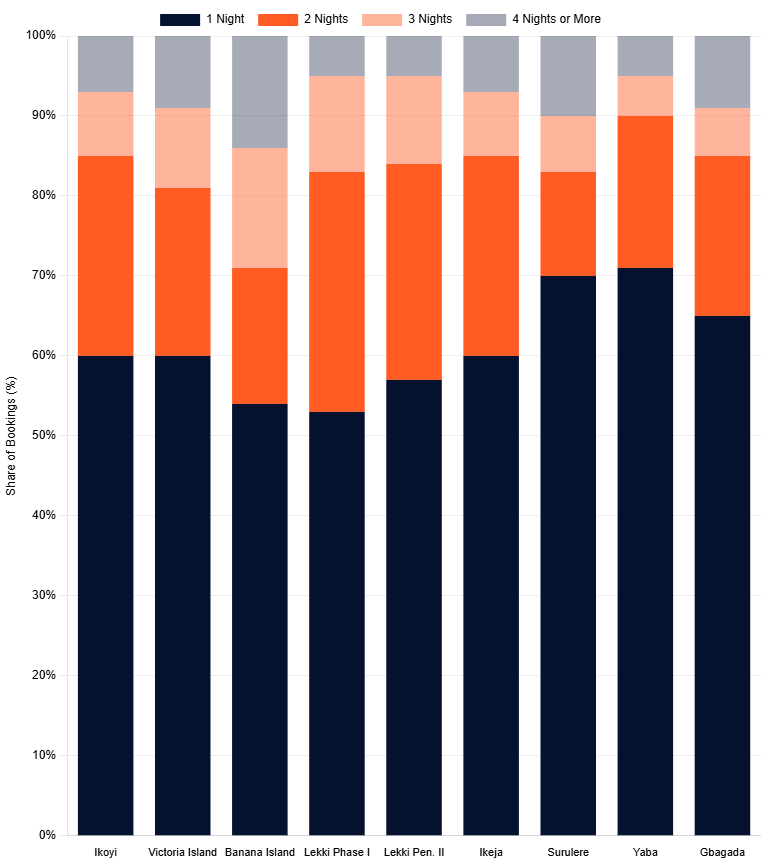
Guest Stay Duration Profile Across Key Lagos Shortlet Submarkets (2024)
Three Myths the Data Corrects
Myth 1: “The Lagos Shortlet Market Is Uniformly High-Yield”
The market’s aggregate revenue creates an impression of universal profitability. The submarket and per-unit data tell a more differentiated story. A one-bedroom unit in Yaba at ₦55,000 ADR with 53% average occupancy generates approximately ₦10.5 million annually. Net of management fees, utilities, platform costs, and furnishing amortisation, the net income is likely ₦6 –7 million on a property with a market value of ₦30–50 million in the current environment. That is a net yield in the range of 12-23%, depending on purchase price, which is meaningful, but not the 30%+ figures that sometimes circulate. The luxury tier at high occupancy is a different calculation. But the luxury tier is also the highest entry-cost tier. Yield comparisons across submarkets only hold when entry costs are held constant.
Myth 2: “December Performance Represents the Market’s True Potential”
The Detty December surge is real and significant, but it is also one month. The same Ikoyi market that hits 85% occupancy in December records 40% in January. Victoria Island moves from 80% in December to 35% in January. Lekki Phase I peaks at 87% in December and starts the year at 39%. Annual average occupancy rates (Lekki Phase I at 63%, Victoria Island at 55%, Banana Island at 65%) are the operative figures for yield modelling, not seasonal peaks. Investors who underwrite primarily on peak-season data will consistently overestimate returns.
Myth 3: “A Good Location Is Sufficient for Strong Performance”
In 2019, a well-located furnished apartment in Lekki or Ikoyi required minimal operational sophistication to achieve strong occupancy. In 2026, with active listings up nearly 50% year-on-year on major platforms and median per-listing revenue declining, the location premium has compressed as a differentiator. Success in the increasingly competitive landscape requires differentiation through premium services, energy efficiency, smart home integration, unique interior design, and strategic marketing. The data reinforces this: the C-grade investability score assigned to Lagos’s Airbnb market reflects occupancy compression and revenue decline at the median listing level, even as the top quartile of professionally managed properties continues to perform strongly.
The Regulatory Risk Dimension: What Banana Island Tells the Wider Market
The Banana Island shortlet suspension reported in early 2026 is the most important single risk event in the Lagos shortlet market in recent years because of what it demonstrates about the market’s regulatory exposure.
The Lagos State Government is expected to enforce increasingly stringent regulations across the sector, covering taxation, safety standards, and customer verification (KYC) protocols. Beyond state-level regulation, residential estates, gated communities, and island enclaves retain their own enforcement mechanisms through management associations and lease covenants. When those mechanisms are deployed, they can move faster and more decisively than state-level regulation, as the Banana Island case illustrates.
For investors, the implication is twofold. First, regulatory risk should be a material input in asset-level due diligence. Properties in residential estate contexts where shortlet operations are ambiguously permitted carry a category of risk that is not captured in historical occupancy or ADR data. Second, the institutional and compliance infrastructure of shortlet operations, covering VAT registration, Lagos Tourism Board registration, and transparent financial reporting, is shifting from a cost centre to a defensive asset. Fully compliant operators are better positioned to navigate increased enforcement than those who have operated informally.
The Cost-of-Construction Overlay: Why New Supply Is Becoming More Expensive
One factor that the shortlet market analysis cannot be separated from in 2026 is the broader construction cost environment. Industry reports documented sharp increases in building material costs between 2023 and 2024: cement prices doubled from ₦4,000 to ₦8,800 per bag; blocks rose from ₦250 to ₦550 – ₦600; iron rods climbed from ₦800,000 to over ₦1,600,000 per tonne; paint doubled in price. By early 2026, a 50kg bag of cement was reportedly selling for between ₦11,500 and ₦15,000, a 340–355% increase from ₦3,300–₦3,500 in March 2021, based on data reported in PropComms’ cement market analysis.
The shortlet investment implication is bidirectional. Rising construction costs constrain new supply formation, which is supportive of occupancy rates in existing well-located inventory. But they also increase the capital cost of new shortlet entry, raise the break-even occupancy required to justify development-to-let strategies, and push fit-out and renovation budgets upward. Investors acquiring existing furnished shortlet stock rather than developing new inventory face a different, and arguably more favourable, cost structure in the current environment.
What the Data Points to for Investors in 2026
The Lagos shortlet market in 2026 is not the same market it was in 2020. It is larger, more structured, more competitive, and more analytically accessible. While the broad growth story is intact, the precision required to generate strong returns has changed. The market has moved out of a phase where generalised exposure to the Lagos shortlet category was sufficient. The phase it has entered rewards specificity: the right submarket, the right unit type, the right operational partner, and the right entry price relative to achievable net yield.
Lekki Phase I remains the highest-liquidity, highest-absolute-revenue market, but also the market with the most acute supply competition.
Victoria Island offers a more institutionally anchored demand base with strong corporate clientele and, if the reported near-doubling of 2025 revenue holds under scrutiny, improving yield dynamics.
The mainland markets, particularly Ikeja with its airport anchor and Yaba with its tech-sector growth trajectory, offer lower entry costs and higher proportional growth forecasts, with correspondingly higher operational and regulatory uncertainty.
The investment decision in this market, as in any maturing real estate segment, ultimately comes down to the quality of the underwriting. That means modelling net yield rather than gross revenue, stress-testing against occupancy compression, building in regulatory risk at the asset level, and assessing the operational capabilities of the management structure before assessing the property itself.