

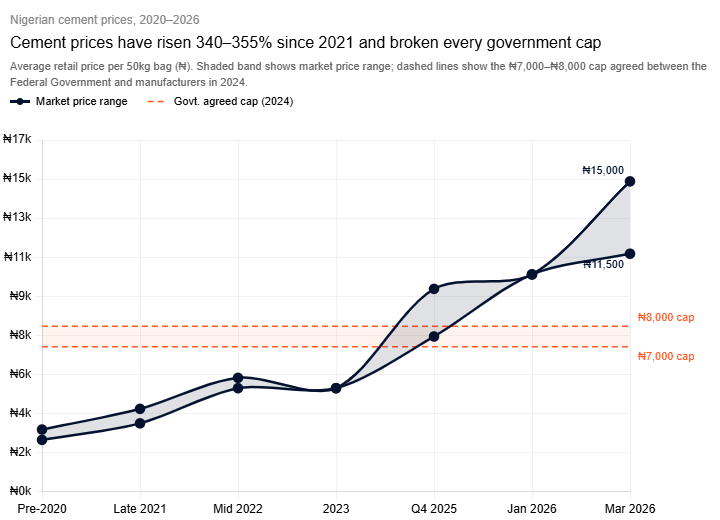
A 50kg bag of cement that cost between ₦3,300 and ₦3,500 in March 2021 now sells for between ₦11,500 and ₦15,000 in March 2026. That is a price increase of 340% to 355% in five years.
In the same period, Nigeria’s three dominant cement producers (Dangote Cement, BUA Cement, and Lafarge Africa) recorded a combined revenue of ₦6.55 trillion in 2025 alone, up 27% year-on-year from ₦5.15 trillion in 2024. In the first half of 2025, the industry’s average operating profit margin was roughly 40%.
This is not simply about inflation or rising material costs. It is about market structure, pricing power, and the consequences of persistently expensive cement on Nigeria’s construction sector, its housing deficit, and the 28 million households that still cannot access decent and affordable housing. For developers and investors reading market signals in 2026, the cement price trajectory is one of the clearest indicators of where project costs, property prices, and rental markets are headed, and why.
The Price Trajectory of Cement in Nigeria
The price increases in Nigeria’s cement market did not arrive suddenly. They accumulated steadily, with each year resetting the floor higher than the previous year. Prior to 2020, a 50kg bag cost ₦2,500–₦3,000. By late 2021 it was ₦3,300–₦4,000. By mid-2022, ₦5,000–₦5,500. Prices were largely flat through 2023, then surged again: from ₦7,500 in Q4 2025 to ₦10,500 in January 2026, a 7.1% single-month increase driven by new tax measures, and to ₦11,500–₦15,000 by March 2026.
In a six-week window in early 2024, prices surged from ₦4,500 to ₦14,000 in some markets, over 150% in under six weeks. Steel rose 20%, sharp sand 25%, and wood and granite also climbed. Building materials account for 35–75% of total construction costs in Nigeria, meaning that a cement price shock compounds into a project-wide crisis almost immediately.
Who Benefits From The Rising Cement Prices?
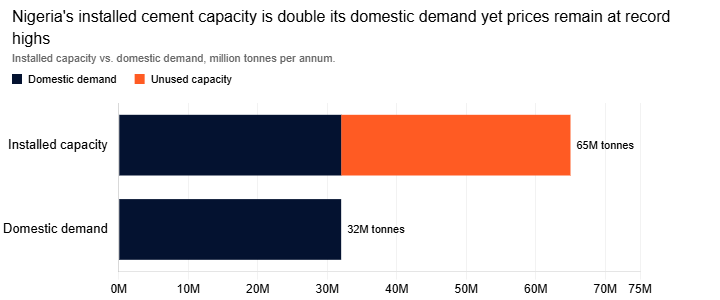
Nigeria’s cement market is controlled by three companies, namely Dangote Cement, BUA Cement, and Lafarge Africa, which collectively hold more than 95% of production capacity. Installed capacity of roughly 65 million tonnes per annum already exceeds domestic demand of approximately 32 million tonnes by a factor of two. Nigeria achieved formal cement self-sufficiency in 2012. Yet prices continue to rise and margins continue to expand.
In the first half of 2025, BUA Cement’s after-tax earnings rose 428% to ₦180.9 billion. Dangote’s H1 revenue grew 17.7% even as volumes fell 4%, with its CEO attributing results to “strategic pricing actions.” Lafarge generated ₦11.64 for every ₦1 spent on operating costs. These are not the margins of a sector under pressure. North American cement producers earn 20–36%; European producers 20–30%; African producers outside Nigeria, 18–30%. Nigeria’s 49% sits in a different category entirely.
A 2026 report by Agora Policy explains that the market operates as a spatially fragmented oligopoly. The dominant producer anchors pricing nationally and smaller producers align accordingly. Geographic dispersion, high logistics costs, and exclusive limestone concessions insulate this structure regionally. National surplus capacity does not translate into price competition because cement markets function region by region. Where plants are isolated, which is most of Nigeria, pricing power is strengthened, not diluted. Manufacturers cite diesel costs, imported gypsum, and a new tax regime as drivers. These pressures are real. But as the report notes: if production costs are the binding constraint, why do Nigerian producers sell cement profitably in export markets at prices lower than those charged domestically?
How Rising Cement Prices Impact Builders and Renters
The costs of elevated cement prices distribute themselves in two directions simultaneously and both compound Nigeria’s housing crisis.
1. Upward: Rents Are Rising
When cement prices rise and construction economics deteriorate, developers delay new supply. Constrained supply in a demand-heavy market means existing stock commands higher rents. Annual rent for a self-contained apartment in Abuja now stands at ₦800,000–₦1.5 million, up from approximately ₦400,000, an increase of 100–275%. Lagos has followed: rents have risen from about ₦400,000 to ₦800,000–₦1 million. Kano and Port Harcourt are also recording significant increases.
Further consequences of rising costs are project delivery delays, scaling down of housing developments, and in some cases, the suspension or abandonment of projects. The Nigerian Senate has reported 11,856 abandoned construction projects nationally. The Bank of Industry estimates ₦21 trillion is required to close Nigeria’s housing gap and notes that access to affordable housing is becoming more difficult for millions of citizens as construction costs rise, urban populations grow, and household incomes decline. Cement price escalation is a direct contributor to all three conditions simultaneously.
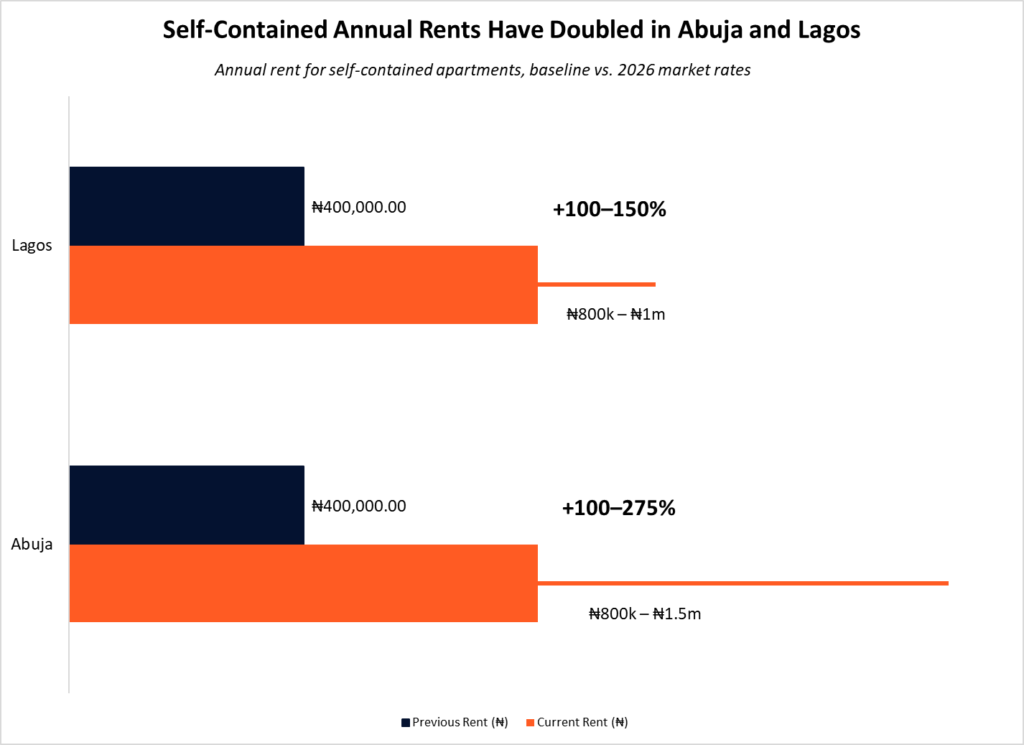
Source: Prof. Timothy Nubi, CHSD, University of Lagos. REDAN/CHSD Press Conference, March 2026
2. Downward: Quality Is Being Compromised
Developers and contractors who cannot pass costs upward because of fixed contracts, price-sensitive buyers, or affordable housing mandates seek relief within the project. The consequence is quieter than a rent increase but no less serious. For instance, reducing the quantities of cement used during construction can lead to reduced load carrying capacity. Other increasingly common cost-saving responses include improper reduction of steel reinforcement, avoidance of qualified structural engineers, and the use of substandard materials.
The data on outcomes is already accumulating. The Building Control Prevention Guild (BCPG) recorded 61 building collapses and 84 fatalities in 2024, which was a period of severe cement price escalation. Federal Government data shows that of Nigeria’s approximately 42.8 million housing units, 75% are already substandard. That figure will likely increase as cost pressure intensifies. Nigeria’s housing deficit is a quality problem not just a quantity problem, and both are being driven by the same upstream cause.
What This Means for Investors and Developers
For developers, the immediate implication is budgetary. A project priced when cement was ₦7,500 per bag faces a cost environment in Q1 2026 that is 35–100% more expensive for that input alone. Budgets built on Q4 2025 assumptions need revision. Where costs cannot be revised upward and variation orders are not secured, they will be absorbed downward. Developers who maintain verified construction standards in this environment are building a durable reputational and commercial asset as the quality gap between projects widens.
For investors, the rental data supports two conclusions that must be held simultaneously. The first is that rental yields in established urban submarkets such as Lagos, Abuja, and Port Harcourt are structurally supported by supply compression. The same cost dynamics reducing construction starts are sustaining demand for existing stock. The second is that a portion of Nigeria’s housing stock carries embedded quality risk not yet reflected in valuations. Construction completed during periods of peak cost pressure, particularly from February 2024 to the present, warrants closer scrutiny on structural specification. Due diligence on construction quality is becoming a material assessment criterion, not a formality.
Outlook
Nigeria’s cement price trajectory reflects a market that captured the benefits of industrial policy, including scale, self-sufficiency, and government support, without delivering competitive pricing. Installed capacity exceeds domestic demand by a factor of two. Operating margins approach 50% in a sector where the global norm is half that. The conditions for lower prices exist. The competitive mechanism to deliver them does not.
The costs fall on developers absorbing shrinking margins, urban tenants paying double for the same apartment, future occupants of buildings constructed under the pressure to reduce what cannot be seen, and on the 28 million households that remain without adequate housing in a country whose cement industry has never been more profitable. The path forward requires competition restoration through open limestone access, separation of production from distribution, pricing transparency, and antitrust enforcement. Without these, the cycle will continue: producers raise prices to protect margins, developers slow construction, housing supply tightens, rents rise, and the housing deficit deepens.