


Nigeria’s housing deficit has been documented and inherited by successive administrations for decades.
Depending on the source, the country’s housing shortfall sits somewhere between 17 and 23 million units, with urban areas absorbing the greatest pressure. Experts estimates Nigeria needs to produce a minimum of 700,000 housing units annually to close this gap by 2050, yet annual production has historically hovered around 100,000 units due to several reasons. This deficit reflects a fiscal reality: the federal and state governments cannot fund infrastructure, health, education, and mass housing simultaneously at the scale the population demands hence, the emergence of PPP initiatives.
Since then, Public-Private Partnerships (PPPs) have emerged as the government’s most prominent response to this constraint. Since the formal adoption of the PPP model in the 2002 New National Housing and Urban Development Policy (NNHUDP), the framework has expanded significantly, with the Infrastructure Concession Regulatory Commission (ICRC) established in 2008 as the governing body overseeing federal PPP transactions. Between 1990 and 2009, more than 51 PPP projects were implemented across Nigeria. By 2013–2014, approximately 66 PPP projects were under preparation, with annual investment growing from $22 million in 1997 to $3.1 billion over the 1990–2009 period, an accumulation of $23.6 billion in total investment.
The data signals momentum, but also obscures a more complicated reality. For investors and developers entering or expanding in Nigeria’s real estate market in 2026, the PPP framework is an opportunity that also requires careful assessment.
The PPP Model in Real Estate
At its core, a PPP in the real estate context is a long-term contractual arrangement in which the government contributes land, regulatory access, and institutional support, while the private sector provides capital, construction expertise, and operational management. The arrangement is designed so that each party does what it does best: the public sector sets the enabling environment; the private sector executes and manages delivery.
In Nigeria, the dominant operational model has been the joint venture, where government agencies and commercial developers share equity, risks, and profits. Structures such as
1). Build-Operate-Transfer (BOT) such as the OMM Project by Land Republic in Oyo state as well other similar projects across Nigeria.
2). Design-Build-Finance-Operate (DBFO), Build-Own-Operate (BOO) which are mostly used for large commercial projects like Sea-Ports and the likes,
…. and the Concession Model have also been deployed across sectors ranging from seaports and airports to healthcare and housing. Policy shapes the modality of PPP transactions, with laws such as the ICRC Act of 2005, the National Policy on PPP launched in 2009, the Public Procurement Act of 2007, and the amended Land Use Act of 1978.
For developers, the Lagos State PPP model clearly illustrates how the framework operates at scale. The state government provides land at a negotiated premium, issues sub-lease agreements and Certificates of Occupancy, grants planning permits, and retains a percentage share of project profits. The private developer prepares all drawings and documentation, arranges and provides project finance, manages construction, and jointly markets the completed units. Between 2007 and 2019, this framework delivered more than 30,000 housing units of varied types across different income brackets and locations throughout Lagos State. While this number is modest relative to the deficit, it demonstrates that the model can generate real output when well-structured and all parties are aligned.
What has been the ROI so far?
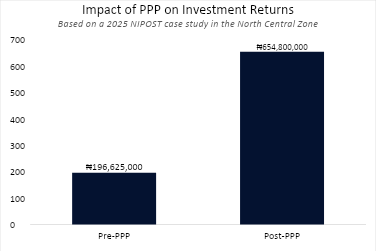
The evidence on PPP financial performance in Nigeria’s real estate context is meaningful but uneven. A 2025 study assessing the impact of PPP on real estate investment returns in the Nigerian Postal Service (NIPOST) North Central Zone found significant improvements in post-PPP performance. Pre-PPP investment values averaged ₦196,625,000 with post-PPP values reaching ₦654,800,000, a result described as “irrefutable quantitative evidence” that PPP adoption generated substantially better financial outcomes. Growth rates in some assets reached 26% post-PPP, compared to single-digit returns prior to partnership implementation.
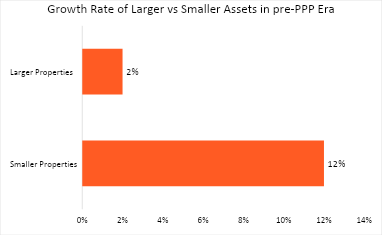
The same study noted that the analysis revealed an inverse relationship between asset size and growth rate under the pre-PPP strategy, with smaller properties (₦512,861) achieving 12% growth compared to larger assets (₦9.5 million) at just 2%. Post-PPP implementation changed this dynamic, with the larger and more complex assets also registering stronger returns. The implication for investors is important: PPP structures, when well-designed, can improve return profiles on assets that would otherwise underperform under solo public or private management.
Structural Challenges of PPPs in Real Estate
Despite its growth trajectory, Nigeria’s PPP experience in housing carries a pattern that data consistently confirms: the model has overwhelmingly served high- and middle-income earners, not the low-income population the policy was originally designed to prioritise. A study of PPP housing found that housing units in Abuja completed under PPP arrangements were sold at 19% to 23.5% above the original agreed price, not because of developer misconduct, but because the government failed to provide pre-agreed infrastructure, forcing developers to absorb and pass on those costs. The impact of that is by the completion of the project, the targeted beneficiaries could not afford the final prices, and units remained vacant until disposal strategies were developed.
Data across Lagos, Ogun State, and Abuja consistently show that PPP housing costs exceed what low-income earners can support, even with National Housing Fund (NHF) contributions. The Federal Mortgage Bank of Nigeria (FMBN), which administers the NHF and provides estate development loans, lacks the scale to fund large projects that can move the needle on the supply deficit. Commercial banks, which have filled part of the financing gap, lend at high interest rates that compress developer margins and push unit prices upward.
The land access problem is equally persistent. Under the Land Use Act of 1978, land administration is vested in state governments, which means the government is simultaneously a partner in PPP transactions and the authority controlling the land input for those same transactions. This dual role has created friction. Compensation processes for indigenous landowners are slow and costly, and these costs are embedded in unit prices. Less than 10% of land in Nigeria is formally documented, generating title disputes and registration delays that affect PPP project timelines and investor confidence.
On the governance side, disagreement, litigation, and revoked concession agreements are recurring features of PPP implementation. The Lagos–Ibadan Expressway, awarded as a BOT concession in 2009, was revoked in November 2012. The Murtala Mohammed Airport Terminal 2 concession remained enmeshed in controversy from its 2007 commissioning. The Nnamdi Azikiwe Airport Abuja concession was also revoked. These reflect a pattern that international investors track when assessing country-level PPP risk.
Where the Opportunity Lies in 2026
Infrastructure-adjacent real estate remains the clearest entry point. PPP-driven infrastructure, such as ports, roads, airports, rail, and energy, creates measurable uplift in surrounding property values and rental demand. The Lekki Deep Sea Port concession and the broader Lekki Free Zone development have generated industrial and logistics-related housing demand that is structurally different from the speculative residential demand seen elsewhere in Lagos. Developers who position themselves in corridors where infrastructure PPPs are active are essentially accessing demand backed by employment and economic activity, not by marketing narratives alone.
Mid-market residential PPP projects in states with established frameworks offer the most legible risk-adjusted return profile. The Lagos model, with its defined government and developer responsibilities, produces housing units across low, medium, and high-income segments with a documented track record of delivery. For developers who can navigate the land acquisition and planning approval process, the joint venture arrangement provides access to government land, institutional co-marketing, and profit-sharing structures that reduce solo development risk.
The land digitisation and administration reform space also warrants attention. Less than 10% of Nigerian land is formally registered, and PPP frameworks are increasingly being used to attract private capital and technical skills for digital land registration systems. For proptech developers and data-driven real estate investors, this represents an early-stage infrastructure play with long-term systemic value, improving title security, reducing dispute risk, and expanding the addressable mortgage market.
What is less clear as an opportunity, at least without significant due diligence, is the low-income affordable housing segment. The research consensus is explicit: PPP for affordable housing in Nigeria has not yet made a significant contribution to low-income supply, and the enabling conditions (subsidised land, cheap long-term finance, NGO involvement, streamlined standards) are not consistently present. Developers who enter this segment without those conditions in place will face the same structural cost pressures that have pushed previous projects up-market.
Key Takeaway
The PPP model is not a panacea for Nigeria’s housing and infrastructure deficit. It is a financing and delivery mechanism that works where the institutional, regulatory, and financial conditions support it and underperforms where those conditions are absent.
For investors and developers, the actionable signal is clear. Infrastructure-linked real estate, mid-market residential PPPs in Lagos and other well-governed states, and Proptech-adjacent land administration plays represent the segments where the risk-return relationship is most legible. The broader housing deficit, particularly the affordable low-income segment, remains a market in waiting: a genuine opportunity, but one that requires government incentive structures, long-term finance mechanisms, and policy consistency that are still being assembled.
In 2026, the PPP scene in Nigeria is segmented, and the quality of that segmentation will determine which transactions generate returns and which generate legal disputes. Investors who enter with a clear view of which projects have the right partners, the right land access, and the right financing structure are positioned to benefit from a framework that, when properly structured, has already demonstrated its capacity to deliver.